
Best IPTV Encoder for Every Budget and Use Case in 2026
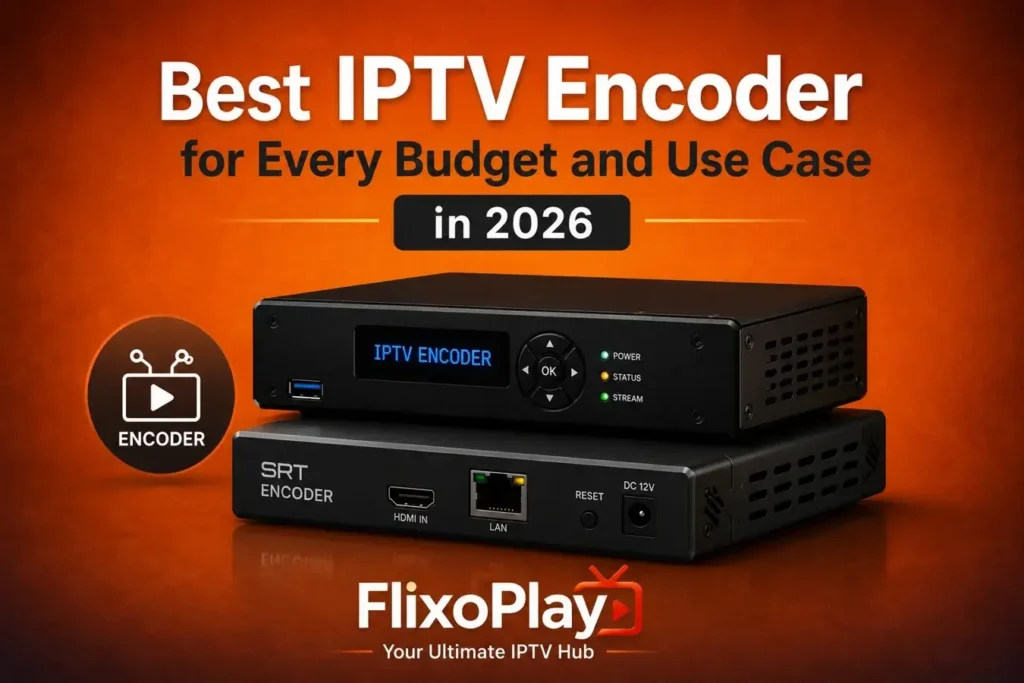
An IPTV encoder is the hardware or software component that converts raw video signals — from HDMI, SDI, or composite sources — into compressed digital streams that can be distributed over an IP network. Whether you are building a hotel IPTV system, running a small broadcasting operation, or delivering live sports content to thousands of simultaneous viewers, the encoder you choose determines your stream quality, latency, and long-term scalability. In this guide, we evaluate the best IPTV encoders across every major price range, from budget-friendly units under $500 to professional-grade systems priced between $1,000 and $3,000, with a particular focus on low latency performance, SRT protocol support, and 4K HEVC encoding capability.
Before selecting a hardware encoder, it is worth understanding what an IPTV service actually involves at the infrastructure level. The encoder sits at the origin of your content delivery chain — its output quality sets the ceiling for everything that follows, including your CDN performance, player compatibility, and end-viewer experience.
What Is an IPTV Encoder and Why Does It Matter?
An IPTV encoder takes an analogue or digital video source and compresses it into a streamable format — most commonly H.264 (AVC), H.265 (HEVC), or AV1 — before transmitting it via protocols such as RTMP, HLS, SRT, or UDP multicast. The encoder’s role is not limited to compression alone. It also manages audio synchronization, stream packaging, forward error correction, and in many cases, direct integration with head-end middleware or CDN ingest points.
For IPTV deployments specifically, low latency is a critical requirement. A hotel or hospitality system serving live sports cannot tolerate a 10–30 second glass-to-glass delay. Commercial-grade IPTV encoders are engineered to keep end-to-end latency below 1–2 seconds under optimal conditions, a performance threshold that consumer-grade encoders rarely meet consistently.
Key Specifications to Evaluate in an IPTV Encoder
Not all encoders are built for the same deployment context. Before committing to a purchase, evaluate each unit against the following criteria:
- Codec support: 264 is universally compatible; H.265/HEVC delivers superior compression at equivalent quality, ideal for bandwidth-constrained or 4K deployments.
- Protocol support: SRT (Secure Reliable Transport) is now the preferred protocol for reliable low latency IPTV delivery over the public internet. UDP multicast remains essential for managed LAN-based IPTV systems.
- Input interfaces: HDMI is standard for most AV sources. SDI inputs are required for professional broadcast equipment.
- Channel count: Single-channel encoders suit point-to-point streams; multi-channel encoders are essential for hotel IPTV systems distributing dozens of live channels simultaneously.
- Latency rating: Verified glass-to-glass latency under 300ms is the benchmark for live sports and interactive applications.
- Management interface: Web-based dashboards, SNMP support, and API access are important for large-scale or remotely managed deployments.
Best IPTV Encoders Under $500: Budget Options That Deliver
The sub-$500 IPTV encoder segment has matured significantly. Units in this range now offer genuine H.264 and H.265 encoding, SRT output, and web-based management — capabilities that were exclusive to professional hardware just a few years ago. These encoders are best suited to single-channel streaming, small venue deployments, or low-budget live event production.
Kiloview E1 (HDMI to IP Encoder)
The Kiloview E1 is one of the most widely deployed budget IPTV encoders globally, and for good reason. It encodes single-channel HDMI input in H.264 at resolutions up to 1080p60, supports SRT, RTMP, RTSP, and UDP output simultaneously, and ships with a clean web-based management interface. Its glass-to-glass latency in SRT mode typically measures below 200ms, making it a credible low latency IPTV encoder for single-source deployments. Retail pricing positions it comfortably under $300 in most markets.
- Resolution: up to 1080p60
- Codecs: H.264
- Protocols: SRT, RTMP, RTSP, UDP, HLS
- Latency: sub-200ms in SRT mode
- Best for: small venues, single-channel live streaming
Magewell Ultra Encode HDMI (Entry Configuration)
Magewell’s Ultra Encode platform offers enterprise-grade reliability in a compact form factor. The entry HDMI configuration encodes 1080p60 in H.264 and H.265, supports SRT with AES-256 encryption, and integrates with professional broadcast workflows via NDI. At its entry price point it sits near the upper boundary of the sub-$500 IPTV encoder category but delivers noticeably superior build quality and software stability compared to generic alternatives.
Best IPTV Encoders Between $500 and $1,000
The $500 to $1,000 IPTV encoder range represents the sweet spot for small business IPTV deployments, educational institutions, and hospitality operators running systems of up to 16 channels. Units in this segment typically add H.265/HEVC encoding, improved redundancy options, and more robust thermal management compared to sub-$500 alternatives.
Haivision Makito X (Single Channel)
The Haivision Makito X is a benchmark product in the professional IPTV encoder market. It delivers H.264 encoding at up to 1080p60 with verified sub-second latency via the Haivision SRT protocol — a technology Haivision co-developed and subsequently open-sourced. The Makito X is widely deployed in defence, broadcast, and enterprise IPTV environments where stream reliability is non-negotiable. For operators running a managed IPTV service, it represents one of the best low cost SRT encoders in this price tier when purchased through certified reseller channels.
- Resolution: up to 1080p60
- Codecs: H.264 with optional HEVC upgrade
- Protocols: SRT, RTMP, RTSP, HLS, TS over UDP
- Latency: sub-500ms glass-to-glass
- Best for: professional broadcast, enterprise IPTV, small business live streaming
Kiloview N60 (4K HEVC HDMI Encoder)
For operators who require 4K HEVC HDMI encoding with low latency SRT output at a price below $1,000, the Kiloview N60 is one of the few genuine options available. It encodes 4K30 in H.265/HEVC and 1080p60 in H.264, supports SRT, RTMP, and UDP output, and ships with a web dashboard for remote management. This makes it the most compelling 4K HEVC HDMI encoder with low latency SRT for IPTV in the under-$1,000 segment. Understanding how IPTV infrastructure handles 4K content is covered in detail in our guide on the difference between IPTV and OTT delivery.
- Resolution: up to 4K30 (H.265), 1080p60 (H.264)
- Codecs: H.264 and H.265/HEVC
- Protocols: SRT, RTMP, UDP, RTSP, HLS
- Latency: sub-300ms in SRT mode
- Best for: 4K live streaming, sports venues, small broadcast studios
Best Multi-Channel IPTV Encoders for Hotel IPTV Systems ($1,000–$3,000)
Hotel and hospitality IPTV systems require multi-channel encoding — typically 8 to 64 channels distributed simultaneously across a property’s managed LAN infrastructure. A budget multi-channel encoder for hotel IPTV systems must balance channel density, encoding quality, management features, and thermal reliability, given that these units often operate continuously for months without interruption. This segment also benefits from proper network segmentation — our guide on IPTV VLAN setup and optimization explains how to architect the network side of a hotel IPTV deployment correctly.
Amino Engel Multi-Channel Encoder Platform
Amino’s encoder platform is widely deployed in European and Middle Eastern hospitality IPTV systems. It supports 8 to 16 simultaneous channel encoding in H.264 and H.265, integrates with major IPTV middleware platforms, and provides SNMP-based monitoring for large property management teams. Pricing in the $1,500 to $2,500 range depending on channel count and codec licensing.
Comprimato JPEG 2000 and HEVC Software Encoder
For operators who prefer software-defined encoding on standard server hardware, Comprimato’s GPU-accelerated encoder delivers professional-grade HEVC output at latencies competitive with dedicated hardware. This approach suits data-centre-based IPTV head-ends where hardware appliances would be impractical to deploy at scale. Licensing costs position it within the $1,000 to $3,000 range for small to mid-scale deployments.
Appear TV XC5100 (Compact Broadcast Encoder)
The Appear TV XC5100 is a compact, rack-mountable multi-service encoder designed for broadcast-grade IPTV head-end deployments. It supports HEVC encoding, multiple input types including HDMI and SDI, and UDP multicast output for managed LAN distribution. Its feature set and build quality justify pricing in the $2,000 to $3,000 range and it is frequently specified in hotel IPTV systems requiring 16 or more encoded channels from a single chassis.
IPTV Encoder Comparison by Budget: Quick Reference
The table below summarises the most relevant specifications across budget tiers:
- Under $500: Kiloview E1 — 1080p60, H.264, SRT, sub-200ms latency, single channel
- $500–$1,000: Kiloview N60 — 4K30 HEVC, SRT, sub-300ms, single channel; Haivision Makito X — 1080p60, H.264/HEVC, SRT, sub-500ms
- $1,000–$1,500: Entry multi-channel platforms — 8–16 channels, H.264/HEVC, UDP multicast, managed LAN
- $1,500–$3,000: Amino, Appear TV, Comprimato — professional multi-channel, SNMP management, middleware integration
How to Choose the Right IPTV Encoder for Your Deployment
Selecting the correct IPTV encoder requires matching the unit’s capabilities to your specific deployment context. The following questions guide that decision:
- How many channels do you need to encode simultaneously? Single-channel encoders cover most small business and live event scenarios; hotel and hospitality systems typically require 8 to 64 channels from a centralized head-end.
- What is your maximum tolerable latency? Live sports and interactive content require sub-500ms glass-to-glass performance. Pre-recorded VOD distribution is far more tolerant of encoding delay.
- Do you need 4K output? 4K HEVC encoding requires significantly more processing power and bandwidth. Confirm that your distribution network can sustain the required bitrate before specifying a 4K encoder.
- What streaming protocol does your platform require? SRT is the current standard for reliable low latency IPTV delivery over unmanaged networks. UDP multicast remains preferable on managed LAN infrastructure.
- Are you delivering to a managed player ecosystem or open devices? Open IPTV player ecosystems — where viewers use apps like TiviMate or XCIPTV-afspiller — may have specific codec or protocol requirements that should be verified against your encoder’s output settings.
SRT Protocol: Why It Matters for Low Latency IPTV Encoding
SRT (Secure Reliable Transport) has become the dominant protocol for professional IPTV encoder deployments over the public internet. Originally developed by Haivision and now maintained as an open-source standard, SRT combines AES-256 encryption, adaptive bitrate recovery, and forward error correction in a single UDP-based protocol stack. The result is a transport mechanism that can maintain sub-second latency even over unstable or high-packet-loss network paths. For any operator choosing a low latency IPTV encoder in 2026, native SRT support is a non-negotiable specification. Operators who are new to the infrastructure side of IPTV delivery may find our complete guide on how to get and set up IPTV a useful foundational reference before specifying encoder hardware.
Ofte stillede spørgsmål (FAQ):
What is an IPTV encoder used for?
What is the best low latency IPTV encoder under $500?
Which IPTV encoder is best for a hotel IPTV system?
What does 4K HEVC mean in an IPTV encoder?
Is SRT better than RTMP for IPTV encoding?
Can I use a software encoder instead of hardware for IPTV?
What bitrate should I use for IPTV encoding?
Konklusion
The IPTV encoder market in 2026 offers credible, high-performance options at every price point from under $500 to well above $3,000. For single-channel low latency deployments, the Kiloview E1 and Haivision Makito X represent the strongest value propositions in their respective budget tiers. For 4K HEVC requirements, the Kiloview N60 delivers exceptional capability below $1,000. For hotel and multi-channel hospitality deployments, Amino and Appear TV platforms provide the channel density, management tooling, and middleware compatibility that professional IPTV systems demand.
When specifying an IPTV encoder, always prioritise SRT support, verified latency figures, and codec flexibility over headline price. The encoder sits at the foundation of your entire content delivery chain — a well-chosen unit will serve reliably for years, while an underpowered one creates problems that no downstream configuration can fully compensate for. For operators still in the planning stage of their IPTV infrastructure, our guide on what an IPTV service involves and our overview of De bedste IPTV-tjenester i 2026 provide essential context before any hardware investment is made